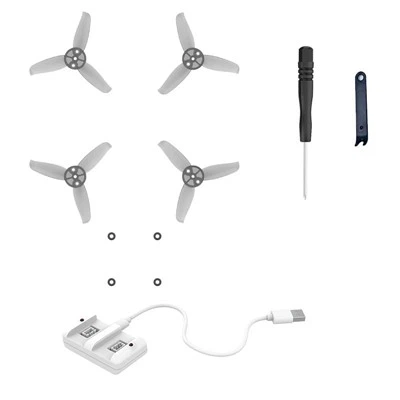
In the realm of modern technology, drones have emerged as versatile tools with a wide range of applications, from aerial photography to industrial inspections. As a supplier of the Mini Coding Drone APP Control Green, I often receive inquiries about the potential uses of our product. One question that frequently arises is whether the Mini Coding Drone APP Control Green can be used to perform search-and-rescue simulations. In this blog post, I will explore this question in detail, examining the capabilities of our drone and the feasibility of using it for search-and-rescue simulations.
Understanding the Mini Coding Drone APP Control Green
Before delving into the potential for search-and-rescue simulations, it's important to understand the features and capabilities of the Mini Coding Drone APP Control Green. This compact and user-friendly drone is designed with beginners and young enthusiasts in mind, offering an accessible entry point into the world of drone technology.
The drone comes equipped with a range of features that make it easy to operate and control. Through the dedicated APP, users can perform a variety of maneuvers, including takeoff, landing, hovering, and directional movement. The APP also offers a coding interface, allowing users to program the drone to perform custom flight paths and actions. This coding functionality not only adds an element of fun and creativity but also provides an educational opportunity for users to learn basic programming concepts.
In addition to its flight and coding capabilities, the Mini Coding Drone APP Control Green is equipped with a built-in camera. While the camera may not offer the same high-resolution imaging as professional-grade drones, it is sufficient for capturing basic aerial footage and images. This feature can be particularly useful for tasks such as environmental monitoring, mapping, and, potentially, search-and-rescue simulations.
Feasibility of Search-and-Rescue Simulations
Search-and-rescue operations are complex and often require specialized equipment and training. However, simulations can play a crucial role in preparing responders for real-world scenarios. By using drones in search-and-rescue simulations, responders can gain valuable experience in operating aerial vehicles, collecting and analyzing data, and coordinating with ground teams.
So, can the Mini Coding Drone APP Control Green be used for search-and-rescue simulations? The answer is yes, with some limitations. Here are some factors to consider:
1. Flight Range and Endurance
One of the primary limitations of the Mini Coding Drone APP Control Green is its flight range and endurance. As a small, consumer-grade drone, it typically has a limited battery life and a relatively short flight range. This means that it may not be suitable for large-scale search-and-rescue operations that require covering extensive areas or flying for extended periods. However, for smaller-scale simulations or training exercises in confined spaces, the drone's flight capabilities may be sufficient.
2. Payload Capacity
Search-and-rescue operations often involve carrying additional equipment, such as sensors, cameras, or communication devices. The Mini Coding Drone APP Control Green has a limited payload capacity, which may restrict its ability to carry specialized search-and-rescue equipment. However, for basic simulations that focus on visual search and data collection, the built-in camera may be sufficient.


3. Imaging and Sensing Capabilities
The quality of the drone's imaging and sensing capabilities is crucial for search-and-rescue operations. While the Mini Coding Drone APP Control Green is equipped with a camera, its resolution and image quality may not be as high as those of professional-grade drones. Additionally, it may not have advanced sensing capabilities, such as thermal imaging or lidar, which can be valuable for detecting and locating survivors in challenging environments. However, for simulations that focus on basic visual search and identification, the camera can still provide useful information.
4. Coding and Automation
One of the advantages of the Mini Coding Drone APP Control Green is its coding functionality. By programming the drone to follow specific flight paths and perform automated tasks, users can simulate the behavior of drones in real-world search-and-rescue operations. This can help responders practice coordinating with drone operators, analyzing data collected by the drone, and making decisions based on the information received.
Use Cases for Search-and-Rescue Simulations
Despite its limitations, the Mini Coding Drone APP Control Green can still be used in a variety of search-and-rescue simulation scenarios. Here are some examples:
1. Classroom Training
In a classroom setting, the drone can be used to teach students about search-and-rescue operations, drone technology, and programming. Students can program the drone to search for simulated targets in a controlled environment, such as a schoolyard or a large indoor space. This hands-on approach can help students develop critical thinking, problem-solving, and teamwork skills.
2. Community Emergency Response Team (CERT) Training
CERTs are volunteer groups that are trained to assist in emergency situations. The Mini Coding Drone APP Control Green can be used in CERT training exercises to simulate search-and-rescue operations in a community setting. Volunteers can practice using the drone to search for simulated victims in a neighborhood or a park, and learn how to communicate and coordinate with other team members.
3. Small-Scale Disaster Response Training
For small-scale disaster response training, the drone can be used to simulate search-and-rescue operations in a limited area, such as a building or a small outdoor site. Responders can practice using the drone to search for survivors, assess damage, and collect data. This can help them gain experience in using drones in real-world disaster situations and improve their response capabilities.
Complementary Products
While the Mini Coding Drone APP Control Green has its limitations, there are other products in our lineup that may be better suited for more advanced search-and-rescue simulations. For example, the Mini Drone for Kids and Beginners Yellow offers similar features to the Mini Coding Drone APP Control Green but may have different flight characteristics and capabilities. The Building Blocks Drone allows users to customize and build their own drones, providing more flexibility and potential for adding specialized equipment. And the Racing Drone for Competition offers high-speed flight and advanced maneuverability, which can be useful for covering large areas quickly in search-and-rescue simulations.
Conclusion
In conclusion, the Mini Coding Drone APP Control Green can be a valuable tool for search-and-rescue simulations, particularly in educational and small-scale training settings. While it has some limitations in terms of flight range, payload capacity, and imaging capabilities, its coding functionality and ease of use make it a suitable option for beginners and those looking to gain hands-on experience with drone technology.
If you are interested in using our drones for search-and-rescue simulations or other applications, we encourage you to contact us to discuss your specific needs. Our team of experts can provide you with more information about our products, offer guidance on how to use them effectively, and assist you in selecting the right drone for your requirements. Whether you are a school, a training organization, or an individual interested in learning more about drone technology, we are here to help you achieve your goals.
References
- International Civil Aviation Organization. (2019). Manual on Remotely Piloted Aircraft Systems.
- Federal Emergency Management Agency. (2018). Community Emergency Response Team (CERT) Program.
- National Institute of Standards and Technology. (2016). Guidelines for Small Unmanned Aircraft Systems (sUAS) Operations in Public Safety.